By Mike, The SugarFreeMan
Founder of SugarDetox.com and the 30-Day Sugar Freedom Challenge
Christmas is now behind us. Mine was awesome! A little cold, but I’m now back in sunny Southern California with the windows open. Thank goodness for fireplaces!
Here’s hoping you were kind to yourself during the holiday and that you don’t have too much of a sugar “jag” to overcome.
A jag is a little like a hangover.
If we overindulge, it just takes a little longer to get back to normal. We crave sugar more. We think about it more. It just takes up more space in our brains.
It’s a simple equation:
The more sugar we have in our systems, the more cravings we have.
So if we overindulged during the holiday, we’re sort of paying our penance mentally and physically now with cravings for more. And I’m sure there are lots of leftover goodies around.

After 35 years sugar-free and helping tens of thousands of people recover from post-holiday sugar spirals, I can tell you this:
The cravings you’re feeling right now aren’t weakness. They’re biochemistry. And there are three specific steps that will reset your system and break the cycle – if you’re willing to actually do them.
This article was review by Dr. Camela McGrath, MD, FACOG. Find more about her here
Step 1: Get All That Holiday Sugar Out of the House
Which leads me to simple secret number one:
Get all that holiday sugar out of the house.
Give it away, throw it away, or flush it down the drain.
I can already hear the objections:
- “But that’s wasteful!”
- “The kids will be upset!”
- “I paid good money for that!”
- “I’ll just have a little bit each day until it’s gone!”
Let me address each of these directly.
The “Wasteful” Argument
You know what’s actually wasteful?
Your health. Your energy. Your mental clarity. Your years of life.
Throwing away leftover cookies is not wasteful.
Throwing away your health by eating those cookies IS wasteful.
The food is already wasted the moment it entered your house.
The only question is:
Will it waste space in your pantry, or will it waste your body?
Choose the pantry.
The “Kids Will Be Upset” Excuse
Your kids will survive without leftover holiday candy. They got plenty during the actual holiday.
What they won’t survive well is watching you model a dysfunctional relationship with sugar – keeping it around “for them” while you struggle with cravings.
Teaching your kids that sugar doesn’t need to be a permanent fixture in the house is one of the greatest gifts you can give them.
The “I Paid Good Money” Rationalization
This is the sunk cost fallacy. The money is already gone.
Eating the sugar won’t get your money back – it will just cost you more in health consequences, weight gain, and continued addiction.
The cost of keeping it is higher than the cost of throwing it away.
The “I’ll Just Have a Little Each Day” Lie
This is your addicted brain talking.
And it’s lying.
You won’t have “just a little.” You’ll have a little… then more… then suddenly daily sugar is back and the holiday jag becomes your new normal.
The presence of sugar in your house guarantees continued cravings.
Remove the sugar, and the cravings begin to fade within days.
How to Actually Do This Step
Right now.
Not tomorrow.
Not after “just this one box.”
- Go through your pantry, fridge, and hidden stashes
(Yes, including the candy you hid from yourself) - Put it all in a garbage bag
(Don’t deliberate – just grab and bag) - Take it directly to the outside trash
(Not the kitchen trash where you can retrieve it) - Or give it away immediately
(Neighbor, food bank, office – just get it out)
It’s time to start protecting yourself as the new year approaches.
Your environment is stronger than your willpower.
Control your environment first.

Step 2: Focus on Quality Foods
(Your Body Is Begging for This)
We’ve had our last hoorah. We sampled it all.
Now it’s time to start the engine of self-care and treat our beautiful, wonderful bodies the way they deserve to be treated.
As I always say:
This is NOT a knowledge gap.
You already know what the right foods are.
Now we just need to eat them first, regularly, and stay away from sweets.
What “Quality Foods” Actually Means
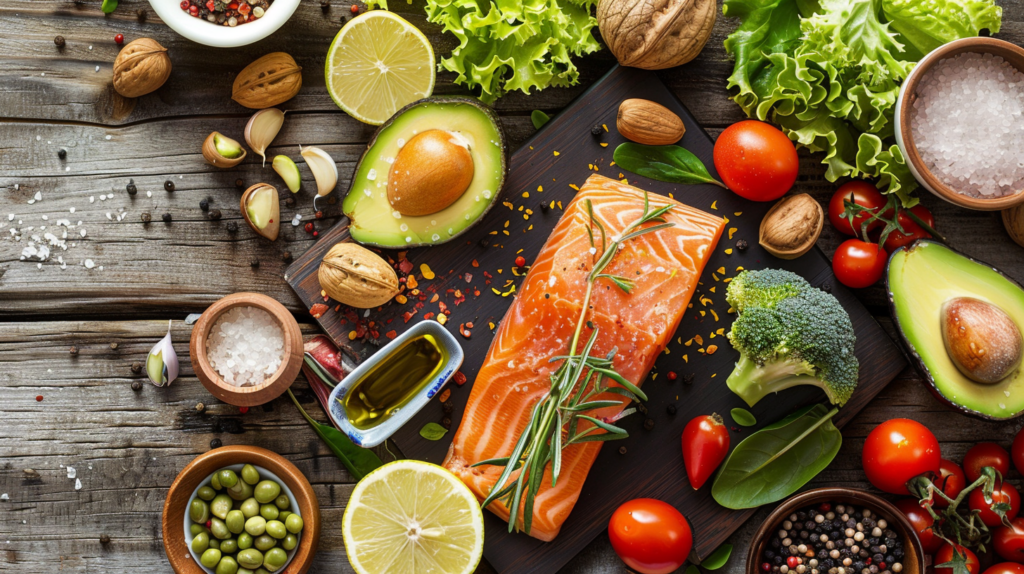
Quality Proteins
- Eggs, fish, chicken, beef, turkey
- Stabilize blood sugar and reduce cravings
- Eat protein at every meal – especially breakfast
Quality Fats
- Avocado, olive oil, coconut oil, nuts, seeds
- Tell your brain you’re satisfied
- Don’t fear fat – fear sugar
Quality Vegetables
- Leafy greens, broccoli, cauliflower, peppers, zucchini
- Fill half your plate at lunch and dinner
- Provide nutrients your sugar-depleted body needs
Quality Carbs (If Needed)
- Sweet potato, quinoa, wild rice
- Optional during a post-holiday reset
- Best added after cravings subside
The “Eat Quality Foods First” Strategy
Breakfast
Protein and fat within an hour of waking. Eggs, avocado, smoothies, or leftover meat. Something substantial that says: “We’re fed. We’re safe.”
Lunch
Protein, fat, and vegetables. Big salads, stir-fries, soups. Make it satisfying to prevent afternoon cravings.
Dinner
Same formula. Fill up on real food so dessert cravings don’t stand a chance.
Snacks (Only if truly hungry)
Nuts, seeds, vegetables with guacamole, hard-boiled eggs. Real food – not “healthy” packaged snacks with hidden sugar.
The principle:
Eat quality foods FIRST, consistently, until satisfied. Cravings fade when your body is nourished.
Why This Works Biochemically
- Blood sugar stabilizes
- Insulin normalizes
- Hunger hormones regulate
- Nutrient deficiencies resolve
- Energy increases
- Cravings decrease within 3–5 days
This isn’t willpower.
This is biochemistry finally working in your favor.
If you’re ready to stop fighting and start following, this is exactly what we built the 30-Day Sugar Detox Challenge for.
Step 3: Let Go of the Struggle
(The Step That Changes Everything)
This step throws people off – but it’s time.
It’s time to stop fighting.
Most people come to us because they want to eat sugar normally.
Let me say this clearly:
I understand.
But here’s the truth:
We’re sugar addicts.
And addicts can’t use their drug of choice “normally.”
The struggle ends the moment you accept that.
What Letting Go Actually Means
- Stop trying to eat sugar “normally”
- Stop fighting alone
- Stop overthinking every decision
- Stop beating yourself up for past failures
Clear rules end the struggle:
No sugar. Period.
The Permission You’ve Been Waiting For
If you need permission – here it is.
I give you permission to let go of the struggle and be kind to yourself.
You have permission to:
- Stop trying to be “normal” with sugar
- Accept that you’re a sugar addict – and that it’s okay
- Ask for help
- Follow a proven plan
- Invest in yourself
- Put yourself first
- Release shame
- Believe this time can be different
- Rest when you’re tired
- Say no to sugar without guilt
You don’t need to earn this permission.
You already deserve it.
Why This Works When Nothing Else Has
Sure, do I want to be the one you trust to drive the bus for a little bit in the new year?
Yes – absolutely. And I know I can help.
But do I care where you get help?
No. I honestly don’t.
I just want you to take care of yourself.
Hundreds of one-on-ones have shown me that when you surrender the reins to someone else and surround yourself with people who are already doing what you want to do, results happen.
I almost typed “miraculous results,” but I’ll leave that for you to judge.
What Happens When You Let Someone Else Drive
When you stop struggling and start following:
1. Decision Fatigue Disappears
Someone tells you exactly what to eat, when to eat it, and what to do when cravings hit. You’re no longer making a thousand decisions a day about sugar – you’re following a clear path.
2. The Mental Burden Lifts
You’re not constantly thinking about sugar, worrying about sugar, or planning your day around sugar. Someone else has already thought it through for you. Your brain finally gets a rest.
3. Support Appears When You Need It
You’re not alone at 9 PM with cravings and nobody to call. You’re part of a community. Someone’s always there – and they’ve been through exactly what you’re experiencing.
4. Accountability Keeps You Honest
When you’re accountable only to yourself, it’s easy to rationalize or give up. When others are watching – with love, not judgment – you show up differently.
5. Proof Becomes Visible
You see others succeeding. Not just on day one, but at month six, year three, year ten. You believe it’s possible because you’re watching it happen.
6. The Struggle Ends
You’re not fighting anymore. You’re flowing. Following. Trusting.
And suddenly – it’s working.
The Post-Holiday Reset That Actually Works
Let me put all three steps together into a complete post-holiday reset plan:
Days 1-3: The Purge and Setup
- Day 1: Remove all sugar from your house. All of it. Today.
- Day 2: Shop for quality foods. Stock your kitchen with the right stuff.
- Day 3: Start eating quality foods at every meal. No sugar. No exceptions.
Expect to feel lousy during this phase. You’re in withdrawal.
That’s normal – and temporary.
Days 4-7: The Physical Reset
- Continue eating quality foods regularly
- Drink plenty of water
- Sleep as much as your body needs
- Reach out for support when cravings hit
- Remind yourself: physical cravings peak around days 3–5, then begin to decrease
By day seven, physical cravings should be significantly reduced if you’ve had zero sugar.
Days 8-14: The Mental Shift
- Your body continues resetting
- Energy stabilizes
- Brain fog lifts
- You start to feel why this is worth it
- Focus on letting go of the struggle – follow the plan, don’t fight it
Days 15-30: The New Normal
- New habits take root
- Sugar no longer dominates your thoughts
- Weight drops without extreme effort
- The struggle you lived with for years is just… gone
- You wonder why you didn’t do this sooner
This is the timeline if you actually DO all three steps – not just read them.
I’ll See You on the Other Side
The holidays are over.
The new year is here.
You can spend another year in the same struggle – thinking about sugar, worrying about sugar, trying to control sugar, failing, beating yourself up, and starting over.
Or you can do these three steps and be done with it.
Remove the sugar from your house.
Focus on quality foods.
Let go of the struggle and let someone help you.
That’s it. That’s the reset.
Simple doesn’t mean easy – but it does mean straightforward.
No complexity. No confusion. Just three clear steps between where you are now and where you want to be.
The question is: will you actually do them?
Or will you nod along, bookmark this for later, and repeat the same pattern?
The post-holiday sugar jag ends when you decide it ends.
Not tomorrow. Not Monday. Right now.
I’ll see you on the other side.
This is where the struggle ends.
Start the 30-Day Sugar Detox Challenge and let your body do what it already knows how to do.
About the Author
Mike Collins, known as “The SugarFreeMan,” has been sugar-free for over 35 years and is the founder of SugarDetox.com. He has helped tens of thousands of people break free from sugar addiction using an evidence-based approach that combines nutritional science with practical behavior change strategies.
Medical Disclaimer
This article is for educational purposes only and is not intended to replace professional medical advice. Always consult a healthcare provider before making significant dietary changes, especially if you have underlying health conditions.
FAQ
Q: What is a post-holiday “sugar jag” and why does it happen? A: A sugar jag is like a hangover from overindulging in sugar – it takes longer to get back to normal, you crave sugar more, think about it more, and it takes up more mental space. It happens because the more sugar in your system, the more biochemical cravings you have. Holiday overindulgence creates a cycle where your body demands more sugar to maintain elevated levels, leading to increased cravings mentally and physically.
Q: Why do I need to throw away leftover holiday treats instead of eating them gradually? A: The presence of sugar in your house guarantees continued cravings. You won’t “just have a little each day” – your addicted brain will escalate consumption and the holiday jag becomes your new normal. Throwing it away isn’t wasteful – keeping it wastes your health, energy, and mental clarity. The cost of eating it (health consequences, perpetuating addiction, continued cravings) is higher than the cost of throwing it away.
Q: How long does it take for sugar cravings to decrease after the holidays? A: Physical sugar cravings peak around days 3-5 of complete sugar elimination, then significantly decrease by day 7-14 if you’ve had zero sugar. Within 3-5 days of eating quality foods instead of sugar, your blood sugar stabilizes, insulin normalizes, hunger hormones regulate, and cravings substantially reduce. However, this timeline only works with complete abstinence – any sugar consumption restarts the cycle.
Q: What are “quality foods” for resetting after holiday sugar overload? A: Quality foods stabilize blood sugar and end cravings: proteins (eggs, fish, chicken, beef) at every meal especially breakfast; healthy fats (avocado, olive oil, nuts) that satisfy and signal you’re fed; vegetables (leafy greens, broccoli, peppers) filling half your plate; and optional limited carbs (sweet potato, quinoa) only after cravings subside. Eating these foods first with regularity leaves no room for sugar cravings when your body is actually nourished.
Q: What does “let go of the struggle” mean for sugar addiction? A: Letting go means: stop trying to eat sugar “normally” (accept you’re a sugar addict and can’t use it moderately), stop fighting alone (accept help and follow proven paths), stop overthinking every decision (clear rule of no sugar eliminates daily decisions), and stop beating yourself up for past failures (you failed due to lack of support, not weakness). The struggle ends when you surrender control to someone who’s succeeded and follow their guidance.
Q: Do I really need permission to quit sugar and be kind to myself? A: Many people unconsciously wait for permission to prioritize themselves. You have permission to: stop trying to be “normal” with sugar, accept you’re an addict, ask for help, follow someone else’s plan, invest in recovery, put yourself first, let go of shame, believe this time can be different, and be kind to yourself during the process. You don’t need to earn this permission – you’re already worthy of taking care of yourself.