By Mike, The SugarFreeMan
Founder of SugarDetox.com and the 30-Day Sugar Freedom Challenge
Two years. That’s how long it took me to string together thirty days without sugar – and I genuinely wanted to quit the entire time.
Every morning I’d commit to it. Every day something would shift, and I’d find myself in the middle of a perfectly logical-sounding reason why today could be an exception and tomorrow would be the real start. Then tomorrow would come and the same thing would happen. For two years.
That’s not a willpower story. Something else is going on.
This article was review by Dr. Camela McGrath, MD, FACOG. Find more about her here
The Gap Between Wanting to Quit and Actually Quitting
Most people who struggle with sugar aren’t casual about it. They’re not halfheartedly considering cutting back. They’ve made real decisions, out loud, sometimes in writing, sometimes to other people. They meant it every time.
And then something overrides it.
That gap – between a genuine commitment and the behavior that follows – is what makes sugar dependency so disorienting. With most problems, if you really want to solve them and you understand what to do, you can make progress. Sugar doesn’t always work that way. You can want it gone, understand intellectually that it’s harming you, and still find yourself reaching for it with a completely convincing internal rationale for why this time is fine.
That’s not weakness. That’s what a substance does when it has established itself in your brain’s reward system.

What’s Actually Happening in the Brain
Sugar triggers dopamine release in the brain’s reward circuitry – the same pathway involved in responses to alcohol, nicotine, and other addictive substances. Research published through the NIH has documented that sugar activates these pathways in ways that produce tolerance, craving, and withdrawal symptoms when removed.
The practical consequence of this is that the brain begins to treat sugar as a survival need. Not metaphorically – neurologically. The same systems that drive you to eat when you’re hungry, to drink when you’re thirsty, start lobbying for sugar. When that happens, your conscious decision to quit is competing against a signal that your brain is generating at a much more fundamental level.
This is why the rationalization sounds so convincing in the moment. Your prefrontal cortex – the part responsible for long-term planning and impulse control – is going up against reward circuitry that’s been reinforced thousands of times. The reward system is faster, louder, and in the short term, more persuasive.
Sugar isn’t hard to quit because you’re not trying hard enough. It’s hard to quit because you’re trying to use willpower against a biochemical process that willpower wasn’t designed to override. Harvard research on food addiction has helped explain why highly processed, high-sugar foods behave differently in the body than whole foods – they’re engineered to hit reward pathways in ways that natural foods don’t, which is part of why moderation strategies fail so consistently for some people.
The Red Light Problem
There’s a way I think about the rationalization loop that makes it easier to see clearly.
Imagine telling yourself every morning: “I’m going to stop at red lights today.” And then every day, when you’re actually at the red light, something in your brain says – “nobody’s around, it’s fine today, you’ll do it right tomorrow.” And you roll through it. And you’re fine. So the next day the same thing happens, because it worked out last time.
That logic holds right up until the day it doesn’t.
Sugar works the same way. Each time you rationalize an exception and it seems fine, the exception becomes easier to justify. The brain files it as: this is acceptable. The pattern cements. And the real damage – metabolic, inflammatory, neurological – accumulates quietly in the background whether you can see it in the moment or not.
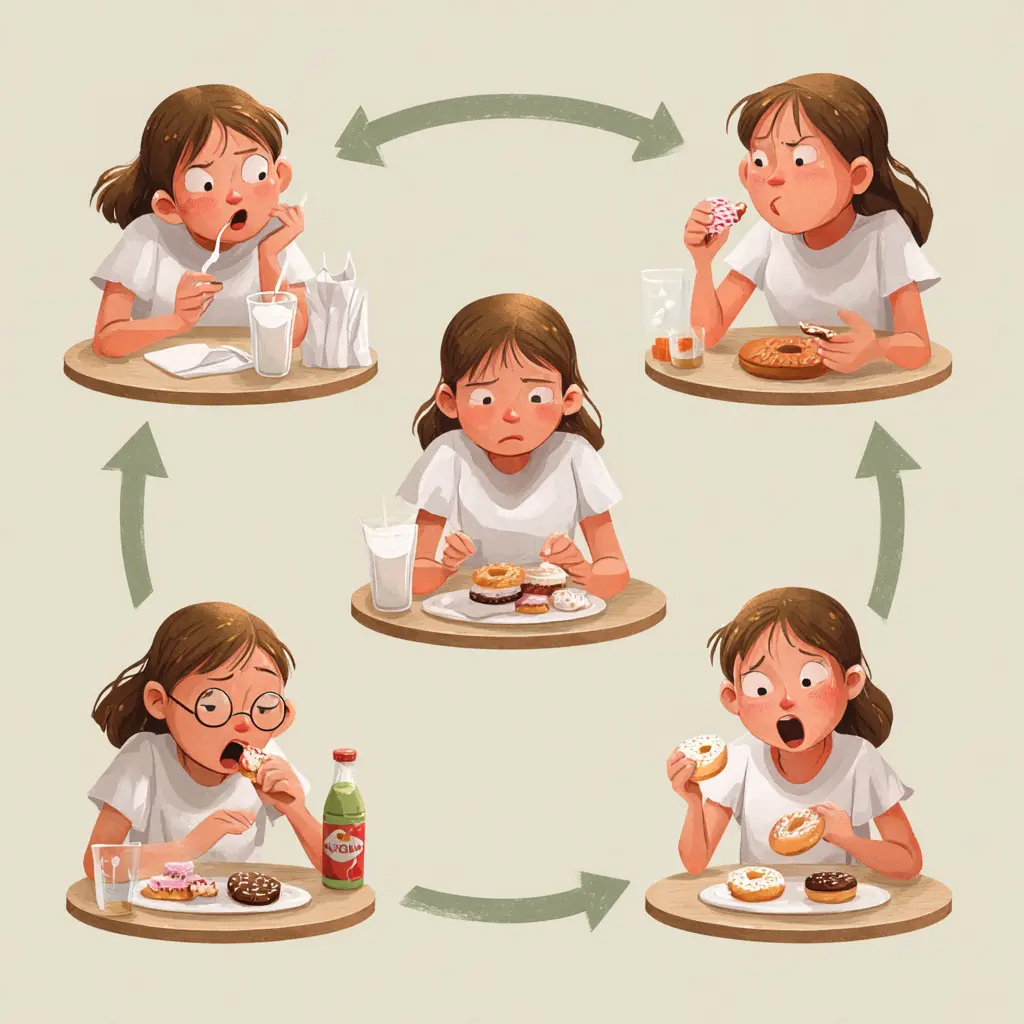
The “I’ll start tomorrow” loop isn’t a planning failure. It’s a symptom of the dependency doing exactly what dependencies do: making the next use feel reasonable while making the cost feel abstract.
Why Information Alone Doesn’t Fix It
Most people who come to me have already read a lot. They know sugar is bad for them. They know what it’s doing to their blood sugar, their energy, their weight, their sleep. Knowing hasn’t been the missing piece.
This is important to understand because it means that reading one more article, getting one more piece of information about why sugar is harmful, is probably not what closes the gap. If knowledge were enough, it would have worked already.
What actually moves the needle, consistently, across 25-plus years of watching people go through this process, is connection. Specifically: being in contact with someone who is going through the same thing at the same time, or who has already been through it and come out the other side.
Not a cheerleader. Not someone telling you that you can do it. Someone who has been inside the same experience and can tell you what it actually felt like – and what they did when the black hole showed up.
I spent two years struggling alone when the solution was available. That’s the part I can’t get back.
It took that long not because I lacked information or commitment. It took that long because I couldn’t pick up the phone and talk to someone who was in it with me. When I finally did, things changed. The difference wasn’t dramatic or sudden – but the direction changed, and it kept going.

The Cultural Layer
It would be incomplete to leave out the environment, because it’s doing a lot of work here.
Sugar is embedded in social life in ways that make it structurally difficult to avoid. It’s in celebrations, in comfort rituals, in how care is expressed between people. Declining it can feel like declining the connection it represents. That’s not an accident – the food industry has spent decades reinforcing those associations deliberately.
Beyond the social layer, sugar is present in enormous quantities in foods that don’t taste obviously sweet. Bread, sauces, salad dressings, processed meats – the average American consumes far more added sugar than recommended according to CDC data, largely from sources people don’t register as sugar. Quitting sugar in that environment requires constant vigilance in a way that quitting something less omnipresent doesn’t.
The cultural normalization also means that struggling to quit sugar doesn’t get treated with the seriousness it deserves. Nobody tells an alcoholic to just have a little less. But “everything in moderation” is the standard advice for sugar, which ignores the dependency mechanism entirely and puts the full burden back on the individual.
What Actually Works
The process of coming off sugar follows a predictable arc. Physical symptoms in the first week. Mental fog and mood shifts. A point around week two where things stabilize, and another around week three where the cravings shift from urgent to manageable. Then, if you get through the first month, something changes more fundamentally – the brain starts to recalibrate, and the signal quiets.
None of that is easy to get through alone. All of it is more manageable when you’re not isolated in it. If you want to stop white-knuckling this and actually understand what’s driving the craving – so you can remove it instead of just fighting it – the 30-Day Sugar Detox Challenge walks you through every day of that first month. What to expect, what to do when the black hole shows up, and how to get to the other side. The people who finish it wake up on day 31 without the constant mental negotiation about food. It’s $19.97:
About the Author
Mike Collins, known as “The SugarFreeMan,” has been sugar-free for over 35 years and is the founder of SugarDetox.com. He has helped over 60,000 people break free from sugar addiction through decades of personal experience and practical, no-nonsense guidance.
Medical Disclaimer
This article is for educational purposes only and is not intended to replace professional medical advice. Always consult with a healthcare provider before making significant dietary changes, especially if you have underlying health conditions.
FAQ
Q: Why is quitting sugar so much harder than quitting other foods? Sugar triggers dopamine release in the brain’s reward circuitry – the same system involved in responses to alcohol and nicotine. Over time, the brain begins treating sugar as a survival need, generating cravings at a neurological level that conscious decision-making struggles to override. This is why people can genuinely want to quit and still find themselves reaching for sugar with a convincing internal rationale.
Q: Is sugar addiction a real thing? Research from the NIH and other institutions has documented that sugar produces tolerance, craving, and withdrawal symptoms consistent with addictive substances. It activates the same reward pathways as drugs of abuse. Whether it meets the formal clinical definition of addiction is still debated, but the behavioral and neurological patterns it produces are real and well-documented.
Q: Why do I keep rationalizing “just one more time” even when I’ve committed to quitting? This is the reward system doing what it does. When the brain has associated sugar with relief or pleasure thousands of times, it generates that craving as an urgent signal – and then produces convincing-sounding justifications for acting on it. The rationalization feels logical in the moment because it’s coming from a part of the brain that processes immediate reward, not long-term planning.
Q: Does knowing sugar is bad for you help you quit? Not much, on its own. Most people who struggle with sugar already know it’s harmful. The knowledge hasn’t closed the gap between intention and behavior, which suggests that more information isn’t the missing piece. What consistently makes the difference is connection – having someone who understands the process and has been through it alongside you.
Q: Why does “everything in moderation” not work for sugar? Moderation strategies assume you have consistent control over consumption once you start. For people with established sugar dependency, that assumption doesn’t hold – the neurological response to sugar disrupts the ability to self-regulate in the same sitting. Telling someone with sugar dependency to use moderation is roughly equivalent to telling someone with alcohol dependency to just drink less.
Q: What actually helps when quitting sugar gets hard? Connection with people who are going through the same process, or who have been through it. Not motivation or encouragement, but genuine shared experience. This is the most consistent factor across long-term success – not a specific diet plan, not supplements, not more information, but not being isolated in the hardest moments of the process.