By Mike, The SugarFreeMan
Founder of SugarDetox.com and the 30-Day Sugar Freedom Challenge
The interviews for the Kick Sugar Summit are clicking along very nicely.
Yesterday I did an interview with a documentary filmmaker who has created, quite possibly, the most informative film on the dangers of sugar ever produced.
I watched the movie and was simply stunned at some of the methods used by the food and beverage producers to make sure that products we buy are “super palatable.”
One could say super addictive.
The movie interviews all kinds of experts and scientists, including folks that work for the food companies formulating new products – candies, sodas, and processed food.

After 35 years of being sugar-free and helping tens of thousands of people break free from sugar addiction, I thought I’d seen it all. But what I learned about “The Bliss Point” changed how I understand why quitting sugar is so damn hard. There’s a multi-billion dollar industry working against you, using neuroscience and food engineering to keep you hooked.
This article was review by Dr. Camela McGrath, MD, FACOG. Find more about her here
What is The Bliss Point? (And Why Should You Be Furious About It)
The thing that I found most fascinating – and infuriating – is called “The Bliss Point.”
The bliss point is described as the point where most people find the taste and “mouth feel” of a product just right.
The scientists working for food companies are looking for that exact point where a product is not too sweet and just sweet enough.
Too sweet and people don’t buy.
Not sweet enough and people don’t buy.
They’re searching for the precise formula that makes your brain light up like a Christmas tree and say: “YES, MORE OF THAT.”
They do this with everything these days.
Spaghetti sauce has to have just the right amount of fat (oil), salt, and sugar to create the perfect taste.
Crackers. Bread. Salad dressing. Yogurt. “Healthy” snack bars. Canned soup. Pasta sauce. Cereal. Literally everything.
The amount of money spent to test, interview, market test consumers, and reformulate until it’s just right is in the millions per product.
Let that sink in.
While you’re trying to quit sugar with willpower and good intentions, there are food scientists in laboratories spending millions to figure out the exact combination of sugar, salt, and fat that will override your willpower and make you crave more.
You’re not fighting your own lack of discipline.
You’re fighting a multi-billion dollar industry that has literally engineered products to be as addictive as possible.
The Science Behind The Bliss Point
Here’s how it works:
Food scientists use what’s called sensory-specific satiety research – basically, they’re studying how to prevent you from getting tired of eating their product.
Normal whole foods have natural stopping points.
Your body tells you when you’ve had enough. You feel full. You stop eating.
But ultra-processed foods engineered to hit the bliss point bypass those natural stopping signals.
They create what researchers call vanishing caloric density – foods that melt in your mouth so your brain thinks you haven’t eaten much, encouraging you to eat more.
They balance sugar, salt, and fat in precise ratios that create maximum palatability without triggering satiety.
They add specific textures, colors, aromas, and even sounds (yes – the crunch) that stimulate multiple senses at once, making the product irresistible.
Research from Yale University shows that ultra-processed foods activate the reward centers of the brain more intensely than whole foods, creating addictive-like eating patterns.
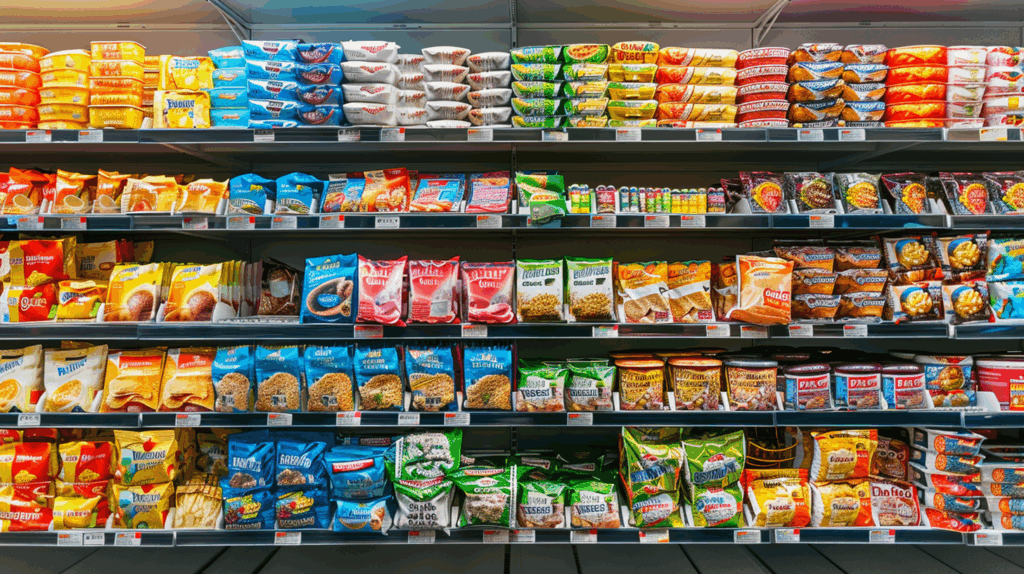
This isn’t food. This is edible entertainment designed to override your biology.
The Enemy You Didn’t Know You Were Fighting
Your sugar issues have an enemy. And it’s not you. It’s not your lack of willpower.
It’s a multi-billion dollar food industry that has invested massive resources into making sure you can’t stop eating their products.
Let me show you the scale of the problem.
The Scale of the Problem
Billions in Research:
Food companies spend billions annually studying how to override your natural satiety.
Millions Per Product:
Each new item goes through millions of dollars in testing and reformulation.
Thousands of Scientists:
PhDs in neuroscience, food science, and psychology are literally hired to make food addictive.
Marketing Everywhere:
Billions spent advertising addictive foods to both adults and children.
80%+ of Supermarket Products Contain Sugar:
Avoiding sugar is nearly impossible.
61 Names for Sugar:
Food labels hide added sugar under more than 61 different names.
What They’re Actually Doing
The documentary shared insider confessions:
“We’re creating foods that are meant to be snacked on continuously.”
→ Designed so you can’t stop.
“We test thousands of formulations to find the perfect balance.”
→ Engineering addiction.
“The goal is to maximize consumption.”
→ They want you eating as much as possible.
“We target the reward centers of the brain.”
→ Neuroscience used against you.
“Children are an important demographic.”
→ Creating lifelong addicts early.
This is the real enemy — not your cravings.
Why Awareness Is Your Most Powerful Tool
Your #1 tool for controlling sugar habits is awareness.
Sugar and added ingredients are everywhere.
Over 80% of supermarket products contain sugar.
But it’s not just sugar alone – it’s the engineered combo of sugar, salt, fat, and additives designed to hit the bliss point and override your natural fullness signals.
Reading Labels is Good – But Not Enough
Reading labels is good, but it’s still not enough.
Why? Because:
- Sugar has 61 different names – They hide it in plain sight
- Serving sizes are manipulated – Making totals seem smaller than they are
- Natural flavors aren’t natural – Often chemical compounds designed to enhance addictiveness
- The bliss point extends beyond sugar – The combination of sugar, salt, and fat is engineered
- Labels don’t show what’s missing – The fiber, nutrients, and whole food components that create natural satiety
You need to understand that if it comes in a package, it’s probably been engineered to be more palatable than nature intended.
👉 Our 30-Day Sugar Detox Challenge
The Psychology of “Adding In” vs. “Taking Away”
We’ve always found that when you “take stuff away” from people, they feel deprived.
They feel like they’re missing out, not able to participate in the social act of eating.
No one likes to be different.
So what we try to do is “add things in.”
We give you new alternatives, recipes, and foods you may have never tried.
People are shocked when they feel like they get to eat so much food.
It’s because the nutrient-dense foods we guide you to contain:
- More fiber – Creates natural satiety
- Better taste – After cravings break, sugary food tastes too sweet
- More nutrients – Your body gets what it needs
- Real satisfaction – Nourishment, not engineered palatability
- Natural stopping points – Your body signals fullness
And they’re much more filling.
Once you add in the good stuff, letting go of the “not so good stuff” becomes easier.
How This Actually Works in Practice
Instead of “you can’t have chips,” we say:
→ “Try these alternatives.”
Instead of “no more soda,” we suggest:
→ Sparkling water with fruit, herbal teas, natural infused water.
Instead of “never eat dessert,” we show you:
→ Treats made with dates, nuts, coconut – real food.
Instead of “avoid all packaged foods,” we teach you:
→ Which packaged foods aren’t engineered to be addictive.
The focus shifts from deprivation to discovery.
You’re not losing foods you love –
You’re discovering foods that love you back.
What Happens to Your Taste Buds
When you quit sugar and engineered foods:
Your taste buds reset.
Within 2–3 weeks:
- Vegetables taste sweeter
- Fruit tastes incredibly sweet and satisfying
- Old “healthy” snacks taste sickeningly sweet
- You taste real flavors again
- Engineered foods taste artificial
- Whole foods taste rich and satisfying
People often say:
“I can’t believe I used to eat that. It tastes like chemicals now.”
Your taste buds were hijacked. But they can be rescued.

The Mental Game (And the Hacks That Make It Easier)
Most of this is mental – but there are hacks that help.
Hack #1: The Two-Week Reset
Commit to two weeks of no sugar.
Not forever – just two weeks.
After this period:
- Cravings drop
- Taste buds reset
- You feel the difference
Continuing becomes a choice, not willpower.
Hack #2: The Crowding Out Method
Don’t focus on what you can’t eat.
Fill your plate with so much good food that there’s no room for the bad stuff.
Vegetables.
Healthy fats.
Quality protein.
Make meals so satisfying sugar becomes irrelevant.
Hack #3: The Pantry Purge
You can’t fight engineered foods if they’re sitting in your house.
If it has:
- More than 5 ingredients
- Ingredients you can’t pronounce
…it goes.
Make your home a safe zone.
Hack #4: The Label Detective Game
Make it fun.
Start reading labels everywhere.
- Look for the 61 sugar names
- Notice how often sugar is in the top 3 ingredients
You’ll naturally build awareness – and even disgust.
Hack #5: The Alternative Database
For every processed food you love, find a real food version.
- Love chips? → Homemade veggie chips, kale chips, roasted chickpeas
- Love ice cream? → Frozen banana “nice cream”
- Love candy? → Dates with almond butter
The alternatives exist.
Hack #6: The Community Advantage
Join people on the same journey.
Recipe swaps.
Support.
Accountability.
You’re no longer fighting alone.
The Bliss Point Is Very Real (And Very Calculated)
Food and soda companies compete all day for your attention – and your children’s.
They engineer products for:
- Maximum cravings
- Addictiveness
- Brand loyalty from childhood
They’re creating the next generation of sugar addicts.
The Children Are Not Alright
- Childhood obesity has tripled since the 1970s.
- Type 2 diabetes – once “adult-only” – is now common in kids.
This is not an accident.
If you won’t fight for yourself, fight for your kids.
Plant Your Flag: Be The Change
If you’re ready to make real changes, join us.
I’ll see you inside.
As Gandhi said:
“Be the change you want to see in the world.”
You want a world where:
- Food nourishes
- Kids grow up healthy
- People aren’t controlled by cravings
- Companies prioritize health
- Real food becomes normal
That change starts with you.
What Planting Your Flag Means
- You decide: No more
- You educate yourself
- You remove engineered foods
- You reset taste buds
- You discover real food
- You model change
- You refuse to be a victim
Your declaration of independence from food engineering.
The Revolution Starts in Your Kitchen
You can’t fix the food industry today.
But you can fix what’s in your home.
Your cart.
Your meals.
Your choices.
Enough of us making better choices forces companies to change.
But it starts with you. Right now. 👉 Join the 30-Day Sugar Detox Challenge
Your Choice Today Matters
Every choice for real food is a vote for a different future.
- You reset taste buds
- You reject engineered addiction
- You model healthy eating
- You protect kids
- You break free from manipulation
The food industry spends billions to keep you hooked.
But you have the power to say no.
Plant your flag.
Be the change.
Join us.
See you on the inside.
About the Author
Mike Collins (“The SugarFreeMan”) has been sugar-free for over 35 years and founded SugarDetox.com. He has helped tens of thousands break free from sugar addiction through science-backed strategies and practical behavior change.
Medical Disclaimer
This article is educational only and not a substitute for professional medical advice. Consult a healthcare provider before making major dietary changes, especially with existing conditions.
FAQ
Q: What is the bliss point in food engineering? A: The bliss point is the precise combination of sugar, salt, and fat that food scientists engineer to create maximum palatability without triggering satiety. It’s the exact point where a product tastes “just right” – not too sweet, not too bland – causing people to crave more and continue eating beyond natural fullness. Food companies spend millions per product testing thousands of formulations to find this perfect formula that overrides your biology.
Q: How do food companies use the bliss point to create addiction? A: Companies employ PhD scientists in food science, neuroscience, and psychology to create “vanishing caloric density” (foods that melt away so your brain thinks you haven’t eaten much), balance sugar/salt/fat in precise ratios that bypass satiety signals, and stimulate multiple senses simultaneously (taste, texture, aroma, sound) to activate brain reward centers more intensely than whole foods, creating addictive-like eating patterns.
Q: How much money do food companies spend engineering addictive products? A: Food companies spend billions annually on food science research, with millions spent per individual product on testing, consumer interviews, market research, and reformulation to hit the perfect bliss point. They employ thousands of scientists working full-time to make products more addictive, plus billions more on marketing to create emotional connections, especially targeting children to create lifelong consumers.
Q: Why is reading food labels not enough to avoid the bliss point? A: Labels hide bliss point engineering through 61 different names for sugar, manipulated serving sizes that make totals seem smaller, “natural flavors” that are often chemical compounds enhancing addictiveness, and not showing what’s missing (fiber, nutrients that create natural satiety). The bliss point extends beyond just sugar to engineered combinations of sugar, salt, fat, and additives that labels don’t fully reveal.
Q: How can I break free from the bliss point trap? A: Break free by: committing to 2 weeks of complete sugar elimination to reset taste buds, using the “crowding out” method (filling up on whole foods), purging engineered foods from your pantry, reading labels to recognize manipulation, finding real food alternatives for every processed food you love, and joining a community fighting the same battle. After 2-3 weeks sugar-free, taste buds reset and engineered foods taste chemical while whole foods taste satisfying.
Q: Why do food companies target children with bliss point engineering? A: Companies target children to create lifelong brand loyalty and the next generation of consumers. They engineer products specifically for developing taste preferences, building addiction patterns early. Childhood obesity has tripled since the 1970s and Type 2 diabetes (once called “adult-onset”) is now common in children – results of calculated food engineering targeting young, developing brains for profit.